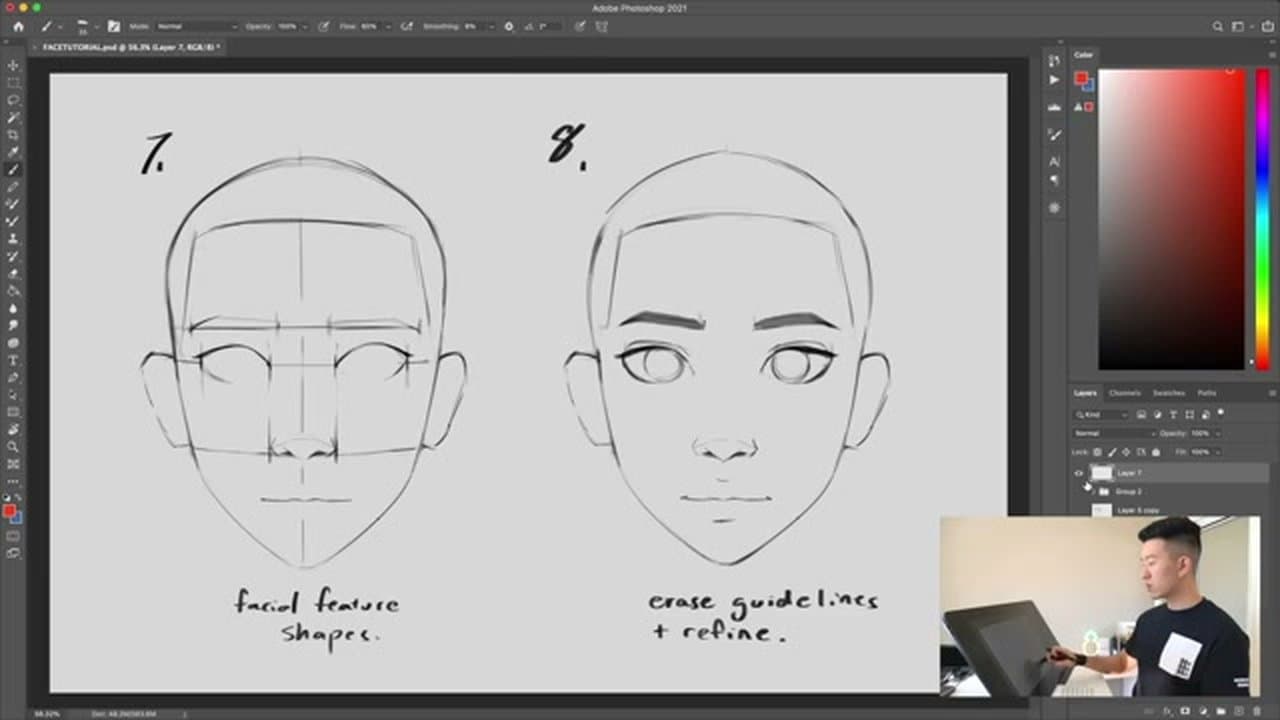
Drawing a believable face is mostly about getting a few measurements right. Sam Yang (SamDoesArts) skips anatomy, planes, and skull structure here on purpose. He's giving you the same beginner method he learned years ago when he started doing portraits, and he still uses it today.
The whole thing comes down to one big idea: the human face follows predictable proportions. Once you know where the brow line, nose line, and chin sit relative to each other, and how far apart the eyes should be, your portraits stop looking awkward. You can use this approach with a pencil and paper or a digital tablet - the measurements work the same either way.
Faces are proportion work more than pencil work. If the sketching and shading here feel like guesswork, the fundamentals - pencil grades, the light-pass method and picking a light source - are at how to draw.
The proportion rules in one place
- Eyes halfway down the head. Measure from the top of the skull, not the hairline.
- One eye-width between the eyes. Left eye, gap, right eye - three equal spaces.
- Nose base about halfway from eyes to chin. Its width matches the inner eye corners.
- Mouth a third of the way from nose to chin. The corners line up under the pupils.
- Ears between the brow and the nose base. They sit behind the jaw, not on the cheek.
These are averages. Real faces break them a little, and that is what makes a likeness. Learn the grid first, then nudge it.
Drawing a face at an angle
Turn the head and the center line curves around the circle like a line of longitude on a globe. Everything follows it. The horizontal guides wrap around the head too, so they become gentle curves instead of flat lines.
The eye on the far side gets narrower and the gap between the eyes shrinks. The nose pushes past the center line toward the far cheek. Push the ear on the near side back toward the middle of the head. Try a three-quarter view once the front view feels easy - it is the angle most portraits use.
Once the placement is right
This page owns placement. The features each have their own lesson: how to draw eyes, how to draw a nose and how to draw lips. Hair changes the whole silhouette of the head, so how to draw hair is a good one to do after.
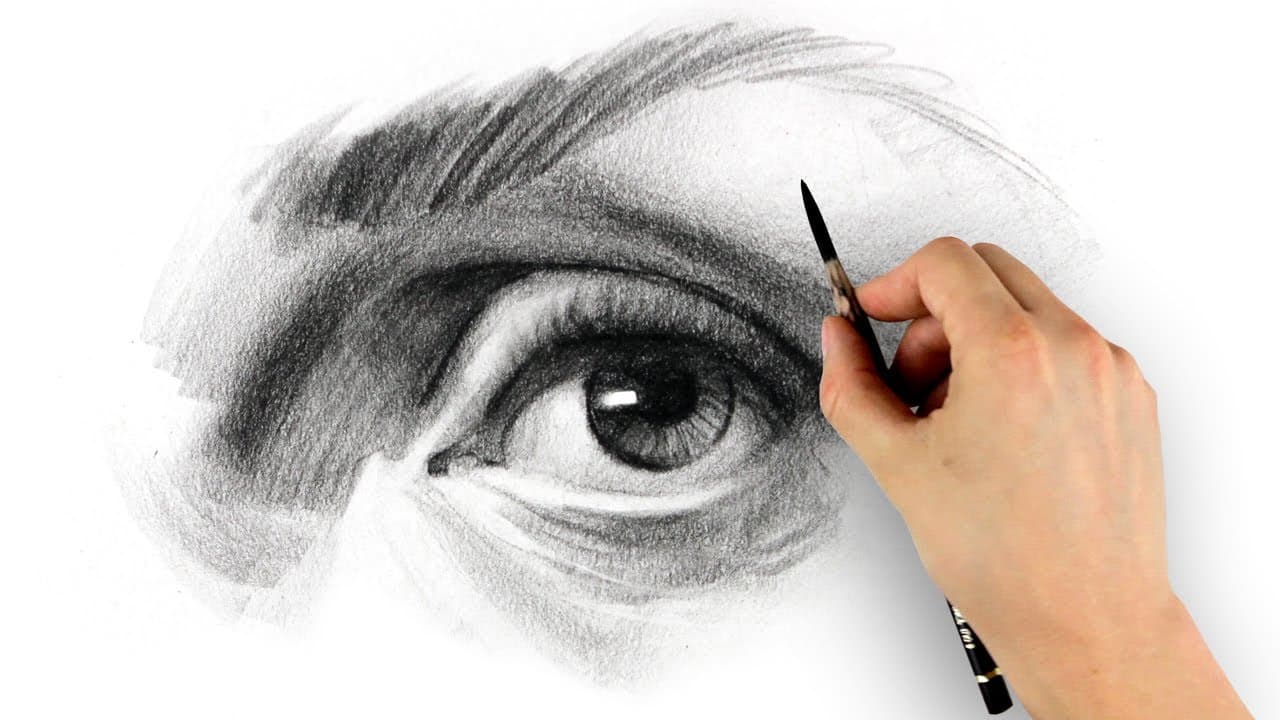
For simple shading, pick one light source and keep to it. Shade the eye sockets, the side of the nose away from the light, the area under the lower lip and the neck under the jaw. Those four patches alone turn a flat outline into a head with form.
Face drawing ideas to try next
- Profile view. Keep the same horizontal lines, but the eye moves back from the front edge and the ear sits right behind the jaw hinge.
- Different ages. A child has bigger eyes set lower on the head and a tiny chin. An older face gets a longer nose, thinner lips and a softer jaw.
- Expressions. Draw the same face three times: smiling, surprised and angry. Only the brows, eyelids and mouth move.
- A cartoon face. Keep the grid and push it. Huge eyes, a dot nose and a wide mouth still look right if they sit on the guide lines.
- The structure underneath. Drawing a skull shows you where the cheekbones and eye sockets really sit.
Common mistakes
- Eyes too high. The number one beginner error. It shrinks the forehead and makes the face look like a mask.
- Forehead too small. The cranium is big. If the hairline hugs the brows, check your thirds.
- Features too big. Eyes and mouth take up less of the face than you think. Measure against the grid.
- Pressing hard on the guidelines. Keep them light so they erase cleanly at the end.