How to Make a Paper Bat (Easy Origami for Halloween)

Based on a video by Art of Fold

Opens their YouTube channel

Steps written out by CraftingStepByStep · Published · Updated

Watch the original video (opens YouTube)
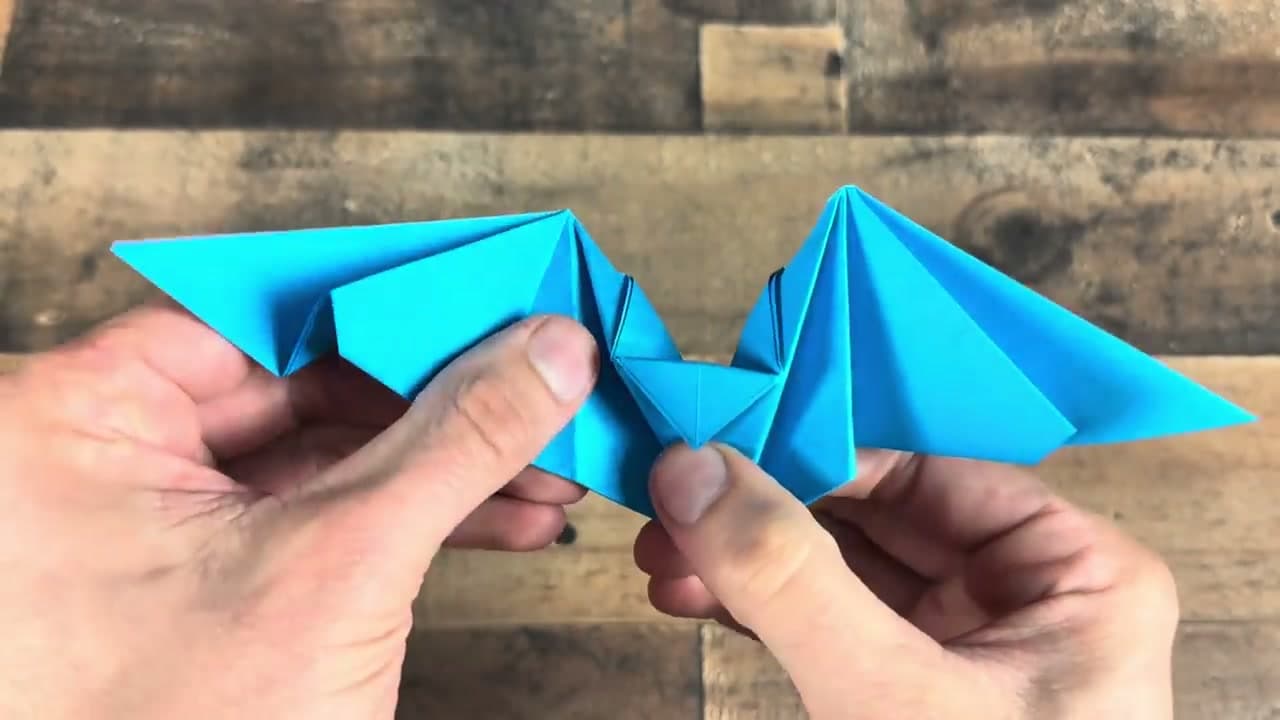
The finished result: How to Make a Paper Bat (Easy Origami for Halloween)
Also in:Other Crafts

Paper bats are the easiest Halloween decoration you can fold. Kids can make one in five minutes, and a flock of them taped to a window or strung along a mantel looks like a proper spooky garland for almost no money.

This is an origami bat folded from one square of paper. No cutting, no glue. The wings get accordion-folded so they hold their shape, and the bottom point pinches into a head for the eyes. Each bat takes about two minutes once you have the sequence.

What you need

  • One square of origami paper, 6 inches a side
  • A fine-tip marker or two googly eye stickers
  • A bone folder, a spoon back, or a thumbnail
  • String for hanging, tape for windows

The easy origami bat

If simple origami bat diagrams have been putting you off, start here. Eight steps, one square, and the only move that takes judgement is the collapse in step 3. An adult can do that collapse for a younger child and hand the triangle back for the wing folds. A class of twenty gets through it in half an hour. New to folding? Start with the origami basics.

Origami bat instructions, start to finish

Crease both diagonals, flip the square over, then crease it in half each way. Those lines let the paper collapse into a waterbomb base, a flat triangle with two flaps front and back. Flatten that into a narrow band with a ridge down the middle and the body is already there. Lift the sides, pull them out left and right, and the silhouette appears. The pleats and the head pinch are the last two moves. That same waterbomb base starts the paper star and the jumping frog, so getting it clean pays off.

Does this one flap?

An origami flapping bat means one of two things: wings that move while the bat hangs, or a pull-tab fold where you tug the tail and the wings beat. This fold gives the first. The pleats work like a paper fan, so the wings bounce on a thread and a row over a doorway looks alive when someone walks past.

For more movement, keep the pleats shallow, stop an inch short of the wing tip, and hang the bat from one thread taped to the middle of the back. For a real pull-tab fold, learn the origami frog.

Halloween ideas for a flock of bats

One bat is a fidget. Six is decor.

  • Garland. Thread taped to each back, six inches apart on fishing line.
  • Window. Double-sided tape, bats climbing the glass in a curve. Lit from inside at night they read as silhouettes.
  • Stair wall. Three sizes from 4, 6 and 8 inch squares, smaller going up.
  • Table scatter. Loose bats between the bowls at a party.

Same logic as a ghost garland on the opposite wall.

What paper to use

Thin origami paper, the kind sold as kami, takes a pleat and holds it. Cardstock fights the collapse and cracks white on every fold. Printer paper works, but the pleats go soft in a day. Black reads as a bat from across the room; orange and purple suit a candy-corn palette. Skip heavy florals, the wing shape vanishes in them. A dollar bill origami bat exists, but that is a different fold on a rectangle.

Troubleshooting

  • One wing sits higher. The opening diagonals missed the corners. Once the wings are pleated it is locked in, so start a fresh square.
  • The paper will not collapse. Soft creases. Refold each over a table edge with a thumbnail.
  • The pleats spring open. Pinch each down its whole length, not just the tip, then press under a book.
  • The head will not stay pinched. A dot of glue stick inside the pinch holds it.
  • The wings tear at the body. Too many layers of too heavy a sheet. Go lighter.

The same diagonal-crease start is behind the origami crane and the origami heart.
What you'll need

Step-by-step guide

8 steps, about 5 minutes. Tap a picture to jump to that step. Your progress saves automatically.

Tick each step off as you go.

  1. Step 1: Start With a Square and Crease the First Diagonal

    Watch this step · 0:18

    Lay a square of origami paper colored-side down. Fold it in half diagonally, corner to corner, so you have a large triangle. Press the crease flat with your finger or a bone folder, then unfold.

    You should now have a flat square with one diagonal crease running through the middle. That crease becomes the centerline of the bat's body, so make it firm.

    Tip:

    Six-inch origami paper is the sweet spot - small enough to handle, large enough to read as a bat shape when finished. Black, orange, or purple all look great. Skip the floral patterns.

    Back to all steps

  2. Step 2: Crease the Other Diagonal

    Watch this step · 0:27

    Fold the paper diagonally the other way, corner to corner, then unfold. The two creases should cross in the exact middle of the square, forming an X.

    Both creases should go all the way to the corners. These four lines do all the structural work for the next collapse, so a sloppy crease here makes the bat lopsided later.

    Back to all steps

  3. Step 3: Collapse Into a Triangle

    Watch this step · 0:40

    Flip the paper colored-side up and fold it in half horizontally and vertically, then unfold. You'll have a star pattern of creases.

    Now bring the two side corners in to meet at the bottom while the top folds down on itself. The paper collapses naturally along the existing creases into a smaller triangle with the open edge at the bottom. Press it flat.

    Tip:

    If the paper resists collapsing, your creases probably aren't sharp enough. Refold each one over the edge of a table to crisp them up, then try again.

    Back to all steps

  4. Step 4: Fold Into a Long Narrow Band

    Watch this step · 1:10

    With the triangle's point facing up, fold the two outer corners down to meet the bottom edge. You now have a flatter diamond shape.

    Tuck the side points inward along the existing creases so the whole figure flattens into a long, narrow horizontal band with a single peaked ridge through the middle. This becomes the bat's body line.

    Back to all steps

  5. Step 5: Fold the Wings Up

    Watch this step · 1:35

    Pick up the band by the center ridge. Lift the left and right sides up so they stand perpendicular to the body, then fold them in toward the middle to create a small kite shape that points up.

    The two upward-pointing triangles will become the wings. The narrow vertical line down the middle is the body. Don't worry about a clean look yet - the accordion folds in step 7 will reshape everything.

    Back to all steps

  6. Step 6: Pull the Wings Out to the Sides

    Watch this step · 2:18

    Open up the two wing flaps and pull them outward and down so they stick out from the body to the left and right. You should now see a recognizable bat silhouette: a small central body with two triangular wings extending out to the sides.

    Press the new creases firmly where each wing meets the body. The wings should sit at roughly the same angle - if one is higher than the other, gently adjust.

    Back to all steps

  7. Step 7: Accordion-Fold the Wings

    Watch this step · 3:25

    This is the step that gives the bat its signature scalloped wing shape. Starting from the body, make a small fold up, then a small fold down, then up again, working out toward the wing tip. You're making little zig-zag pleats across the wing.

    Repeat on the other wing, trying to match the spacing. Press each crease flat as you go. Three or four pleats per wing is plenty - the wing should look like a tiny paper fan when you're done.

    Tip:

    If your pleats are uneven, that's fine. Bats in real life have raggedy wings. Aim for the general accordion look rather than perfect symmetry.

    Back to all steps

  8. Step 8: Pinch the Head and Add Eyes

    Watch this step · 4:28

    Hold the body in the middle and gently pull the wings apart so they spread to either side. The bottom point pinches into a small triangle - that's the bat's head.

    Use a fine black marker to dot two eyes on the head triangle, or stick on two small googly eyes if you have them. Tape a thread to the back of the body to hang it from the ceiling, or stick a strip of double-sided tape on the back to mount it to a window.

    Tip:

    Make a whole flock in different colors and string them together with thin fishing line for an instant Halloween garland. Five or six bats spaced six inches apart looks proper spooky.

    Back to all steps

Keep going

How to Make a Paper Popper - Loud Snap From One Sheet of Paper

Products Used

The Checklist

How to Make a Paper Bat (Easy Origami for Halloween)

Tools
2
Materials
4
Steps
8
Video
5 min

Tools we recommend

As an Amazon Associate we earn from qualifying purchases. Links on this page may be affiliate links - clicking them and buying doesn't change your price, but helps support CraftingStepByStep.

Tags

The Crafter's Weekly

New paper crafts tutorials, every Sunday

One short email with the week's best step-by-step guides. Free, no spam, unsubscribe anytime.

Test your knowledge

Did the lesson stick? Start with this one.

5 questions covering what you just read. No signup, no score saved, and you can stop after this one.

Question 1 of 5

The first two folds of the bat are both diagonal corner-to-corner. Why?

Quick reference

Key takeaways from How to Make a Paper Bat (Easy Origami for Halloween)

5 questions, answers, and one-line explanations. Tap to expand.

  1. 1.The first two folds of the bat are both diagonal corner-to-corner. Why?

    Answer: The crossed diagonals form the structural X that guides the next collapse

    The X is the foundation; sloppy diagonals make the bat lopsided later.

  2. 2.What origami base does this bat fold collapse into?

    Answer: A waterbomb base (triangle with two flaps front and back)

    The waterbomb base is also used for stars, frogs, and many other origami shapes.

  3. 3.What gives the bat its signature scalloped wing shape?

    Answer: Small accordion folds (zig-zag pleats) across each wing

    Three or four pleats per wing make it look like a tiny paper fan.

  4. 4.How is the bat's head formed?

    Answer: The bottom point pinches into a small triangle as you spread the wings

    Pinching gives you the head triangle; eyes get dotted onto it.

  5. 5.What's the easy way to display the finished bat?

    Answer: Tape thread to the back of the body and hang it from the ceiling

    A thread on the back lets it hang and 'flap' with air movement.

Did this work for you?

What's next

Related collections

Curated theme pages that include this tutorial.

Similar tutorials

Hand-picked next reads based on the one you just finished.

Liked this paper crafts tutorial?

Pick the crafts you want to hear about. One email every Sunday with new step-by-step tutorials. No spam, easy to unsubscribe.

Get more like this in your inbox

Weekly digest. Pick the categories you want. Unsubscribe anytime.

Send me tutorials about

We only email about new tutorials. Easy unsubscribe anytime.