How to Make a Paracord Bracelet (Cobra Weave)

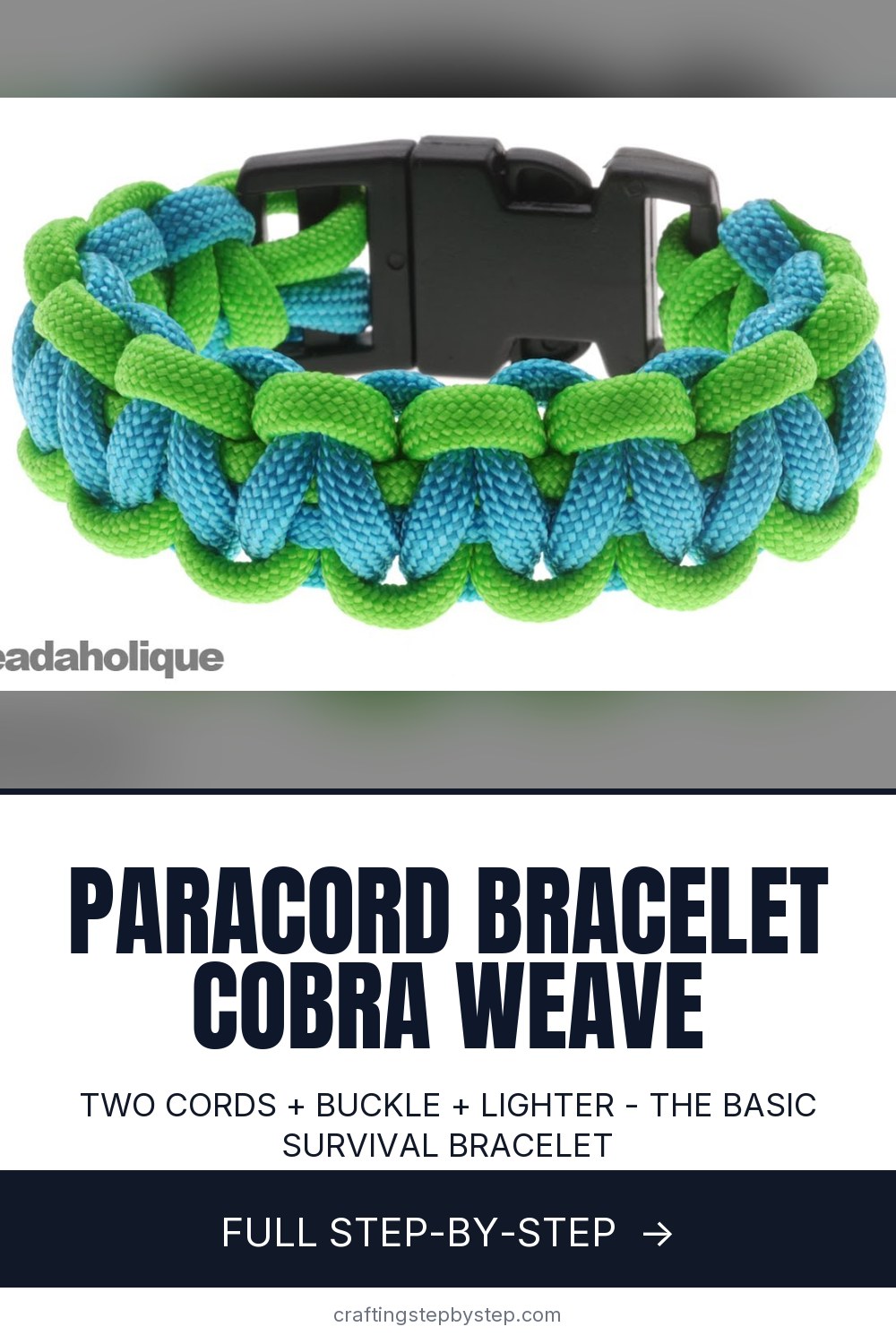
The finished result: How to Make a Paracord Bracelet (Cobra Weave)
  • Difficulty: Easy
  • About 45 minutes
  • 7 steps

You tapped Save

Save this project for later

We'll email you a link, no password.

How to Make a Paracord Bracelet (Cobra Weave)

  • Your saved projects in one list
  • Your ticked steps on any device

Check your inbox for an email from us. Not there? Look in your spam folder.

Print

Steps written out by Crafting Step by Step from Beadaholique - STORE CLOSING, Everything on Sale!'s video (opens YouTube) (14:51). Published .

Also in:Crafts

The cobra weave is the entry-level paracord bracelet, and once you've made one you know the knot behind most of macrame. Two cords, one plastic buckle, and a square knot repeated until you reach the buckle on the other side.

Megan from Beadaholique uses two colors of 4mm paracord (550 cord), a 0.6 inch plastic buckle, a basic disposable lighter, and either flush cutters or strong scissors. The disposable lighter matters - a torch lighter burns straight through paracord.

Plan on about an hour for your first one. The hardest part is remembering to alternate the knot direction - left-then-right, then right-then-left. If you forget, the bracelet twists into a spiral instead of laying flat.

How much paracord you need

The common rule is about one foot of cord per inch of finished bracelet. A cobra weave eats cord fast because each knot wraps the core twice. For a two-color build, split that between the two colors and cut each a little long. Spare cord costs pennies. Running out two knots from the end means starting over.

Measuring your wrist

Wrap a strip of paper or a soft tape around your wrist bone and mark where it meets. Add about an inch for comfort. The buckle takes up a bit of length too, so knot until the bracelet with the buckle closed matches that number. Fit it on your wrist every few inches as you go.

550 vs micro cord

550 cord is the standard 4mm paracord, rated to hold 550 pounds, with seven inner strands. It makes a chunky bracelet and is the easiest to learn on. Micro cord is about 1 to 1.2mm, makes a slim bracelet that looks like jewelry, and takes far longer because you tie many more knots per inch. Learn on 550.

Sealing the ends safely

Hold the flame to the cut tip until it turns dark and glossy, then press it flat with the metal side of the lighter. Never use your finger. Molten nylon sticks to skin and keeps burning. Work over a non-flammable surface, keep the flame small, and let the end cool for a full minute before you touch it.

Cobra vs king cobra vs fishtail

WeaveLookCord
CobraFlat, even, the classicAbout 1 ft per inch
King cobraA second cobra layer on top, thick and heavyRoughly double
FishtailThinner, woven over-and-under patternA little less than cobra

The survival angle

Many people wear a paracord bracelet because it unravels into several feet of usable cord. Cut the sealed ends, pull the knots apart, and you have a length of strong line for a shelter tie-down or a shoelace. The inner strands pull out for fishing line or thread.

Common mistakes

  • Uneven knots. Snug every knot with the same pull or the edges go lumpy.
  • Losing the alternation. If one edge shows the same color twice, undo back to that knot and redo it.
  • Too tight. Paracord does not stretch. Test the fit before the final knot.

More knots to try

The cobra knot is the same move as a macrame square knot, and the buckle attaches with a lark's head knot. For a softer bracelet with no buckle, try a friendship bracelet finished with a sliding bracelet knot.

Free printable

Print the steps and supply list for this project

One page you can take to the table. Free with a free account, no password.

Get the free printable

What you'll need

Free, for this project

Get this checklist by email

  • All 6 tools and materials, with tick boxes
  • A link to print all 7 steps on paper, to keep by you while you craft

No password. The whole tutorial stays free on this page.

Quick answer

Make a paracord bracelet with the basic cobra weave. An easy project: about 45 minutes. Materials cost about $5 to $10. You need 6 things, including 550 paracord, color A, 550 paracord, color B and Plastic side-release buckle. The 7 steps start with gather Supplies and Measure Your Paracord, attach the Cord to the Buckle, fuse the Two Cords Into One Core, tie the First Cobra Knot, reverse the Knot for the Alternating Pass and knot to Length.

Step-by-step guide

7 steps, about 15 minutes. Tap a picture to jump to that step. Your progress saves automatically.

Tick each step off as you go.

  1. Step 1: Gather Supplies and Measure Your Paracord

    Watch this step · 1:40

    You'll need two colors of 550 paracord, a 0.6 inch plastic buckle, a basic disposable lighter, and either flush cutters or strong scissors. Don't substitute a torch lighter - it'll burn straight through nylon paracord.

    Cut about a foot of paracord per inch of finished braid. For a seven-inch wrist, you want five inches of knotting (two inches gets eaten by the buckle), which means about five feet of cord, but cut six feet to give yourself slack to work with.

    Tip:

    Measure your wrist and add an inch for comfort. The buckle adds two more inches when closed - so a six-inch wrist plus one inch comfort plus two inches buckle = seven inches total bracelet length.

    Back to all steps

  2. Step 2: Attach the Cord to the Buckle

    Watch this step · 3:20

    Separate the male and female halves of your buckle. Pick one cord, fold it so a small loop sticks up, and pass that loop through one of the slots on the female buckle.

    Pull the loop out the back, then thread the two long ends of the cord through the loop and pull tight. That's a lark's head knot. The buckle is now anchored to the cord.

    Tip:

    Pull the loop tight against the buckle slot. Any slack in the lark's head knot makes the whole bracelet wobbly later.

    Back to all steps

  3. Step 3: Fuse the Two Cords Into One Core

    Watch this step · 6:25

    To get a two-color bracelet you need to join the second color onto the first so the core running down the middle has both colors hidden inside. Trim a tail on the first cord, pull back the outer sheath about three-quarters of an inch, and snip out the inner threads. That gives you a hollow tube.

    On the second cord, melt the cut end with the lighter until it's dark and shiny, then press it against the side of the lighter to harden it. Once cool, push the hardened end into the hollow of the first cord. Then briefly hold the join in the flame to fuse the two together.

    Tip:

    The fuse needs to land high up inside the bracelet so the knotting hides it completely. About an inch and a quarter from the buckle is the sweet spot.

    Back to all steps

  4. Step 4: Tie the First Cobra Knot

    Watch this step · 10:05

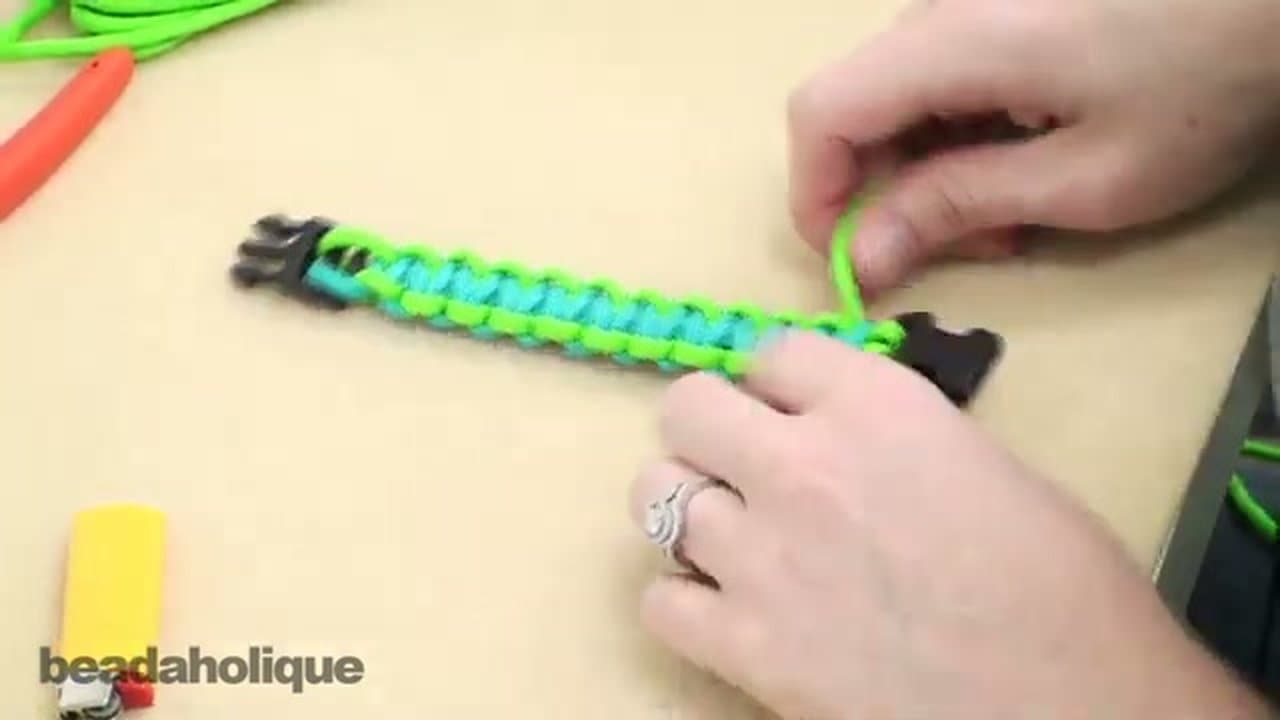
    Now you've got two long working cords on the outside and the fused core down the middle. Take the LEFT cord and lay it OVER the core, making a backward 4 shape. Take the RIGHT cord and lay it OVER the tail of the left cord, then bring it UNDER the core and UP through the loop made by the left cord.

    Pull both ends out sideways and snug them down against the buckle. That's one half of a cobra knot.

    Tip:

    Megan's mnemonic: over, over, under, through. Repeat that to yourself the first ten times you tie the knot and your hands will memorize the rhythm.

    Back to all steps

  5. Step 5: Reverse the Knot for the Alternating Pass

    Watch this step · 9:50

    Now the same knot, mirrored. Take the LEFT cord and lay it UNDER the core. Take the RIGHT cord and lay it UNDER the left cord, then bring it OVER the core and through the loop. Pull tight.

    The mnemonic is: under, under, over, through. Alternating these two halves is what keeps the bracelet flat. If you accidentally do the same direction twice in a row, the braid starts spiraling - back up and redo it.

    Tip:

    Watch the side edges of your braid. If you're alternating correctly, the same color shows on each side every other knot. If both edges are the same color non-stop, you skipped an alternation.

    Back to all steps

  6. Step 6: Knot to Length

    Watch this step · 12:00

    Keep alternating - over-over-under-through, then under-under-over-through - all the way down. Snug each knot tight against the previous one before moving on.

    Stop when the braid is the right length to meet the male half of the buckle. Pass the core through the male buckle and tie one final knot, locking the buckle in place. Now both ends of the bracelet are anchored.

    Tip:

    Hold the work-in-progress against your wrist every few inches to check fit. Easier to stop short and undo a few knots than to discover at the end that the bracelet is too tight.

    Back to all steps

  7. Step 7: Trim and Seal the Ends

    Watch this step · 12:50

    Cut the loose ends down to about an eighth of an inch above the final knot. Melt the tip with the lighter until it's molten, then quickly press the side of the lighter against it to flatten and widen the end.

    That mushroom of melted nylon is what keeps the cord from pulling back through the knot. Let it cool fully before touching - molten paracord burns. Repeat on the second end and you're done.

    Tip:

    The lighter ends up gunky from the melted paracord. Let it cool, then scratch the gunk off with a fingernail. Don't use Grandpa's nice Zippo for this.

    Back to all steps

How to Make a Beaded Bracelet

Keep going

How to Make a Beaded Bracelet

8 steps · about 8 minutes

Keep going with jewelry making

More on this topic, picked for this paracord bracelet.

You reached the last step

Save this project to come back to it

Your ticked steps, the free printable and your other saved makes, together in My Projects. Free, no password.

You tapped Save

Save this project for later

We'll email you a link, no password.

How to Make a Paracord Bracelet (Cobra Weave)

  • Your saved projects in one list
  • Your ticked steps on any device

Check your inbox for an email from us. Not there? Look in your spam folder.

Free printable

Printable sheet and shopping list for this project

The bonus is hidden until you sign up.

Free with a free account, no password. Every step above stays open to everyone.

Products Used

The Checklist

How to Make a Paracord Bracelet (Cobra Weave)

Tools
3
Materials
3
Steps
7
Video
15 min

Tools we recommend

As an Amazon Associate we earn from qualifying purchases. Links on this page may be affiliate links - clicking them and buying doesn't change your price, but helps support Crafting Step by Step.

Tags

The Crafter's Weekly

New jewelry making tutorials, every Sunday

One short email with the week's best step-by-step guides. Free, no spam, unsubscribe anytime.

Test your knowledge

Did the lesson stick? Start with this one.

5 questions covering what you just read. No signup, no score saved, and you can stop after this one.

Question 1 of 5

What's the entry-level paracord bracelet weave?

Quick reference

Key takeaways from How to Make a Paracord Bracelet (Cobra Weave)

5 questions, answers, and one-line explanations. Tap to expand.

  1. 1.What's the entry-level paracord bracelet weave?

    Answer: Cobra weave

    Cobra weave is the gateway paracord knot. Two cords, one buckle, square knot repeated until you reach the other side.

  2. 2.How much paracord do you need per inch of finished bracelet?

    Answer: About one foot

    About a foot of paracord per inch of finished bracelet. Eight inches finished = eight feet of cord.

  3. 3.Megan's mnemonic for the first cobra knot direction is:

    Answer: Over, over, under, through

    Over the core, over the left tail, under the core, through the loop. Say it out loud the first ten times.

  4. 4.Which tool does Megan warn NOT to use for sealing the ends?

    Answer: A torch lighter

    Torch lighters burn straight through nylon paracord. Use a basic disposable lighter to mushroom the tip.

  5. 5.Why fuse the second cord into the first inside the core?

    Answer: Lets you change colors invisibly

    Fusing the second color into the core means both colors hide inside. The knotting on the outside reveals just the alternating outer pair.

Did this work for you?

What's next

Related collections

Curated theme pages that include this tutorial.

Similar tutorials

Hand-picked next reads based on the one you just finished.

Liked this jewelry making tutorial?

Pick the crafts you want to hear about. One email every Sunday with new step-by-step tutorials. No spam, easy to unsubscribe.

Get more like this in your inbox

Weekly digest. Pick the categories you want. Unsubscribe anytime.

Send me tutorials about

We only email about new tutorials. Easy unsubscribe anytime.