How to Draw a House: Cartoon Cottage Step by Step

Based on a video by Art for Kids Hub

Opens their YouTube channel

Steps written out by CraftingStepByStep · Published · Updated

Watch the original video (opens YouTube)
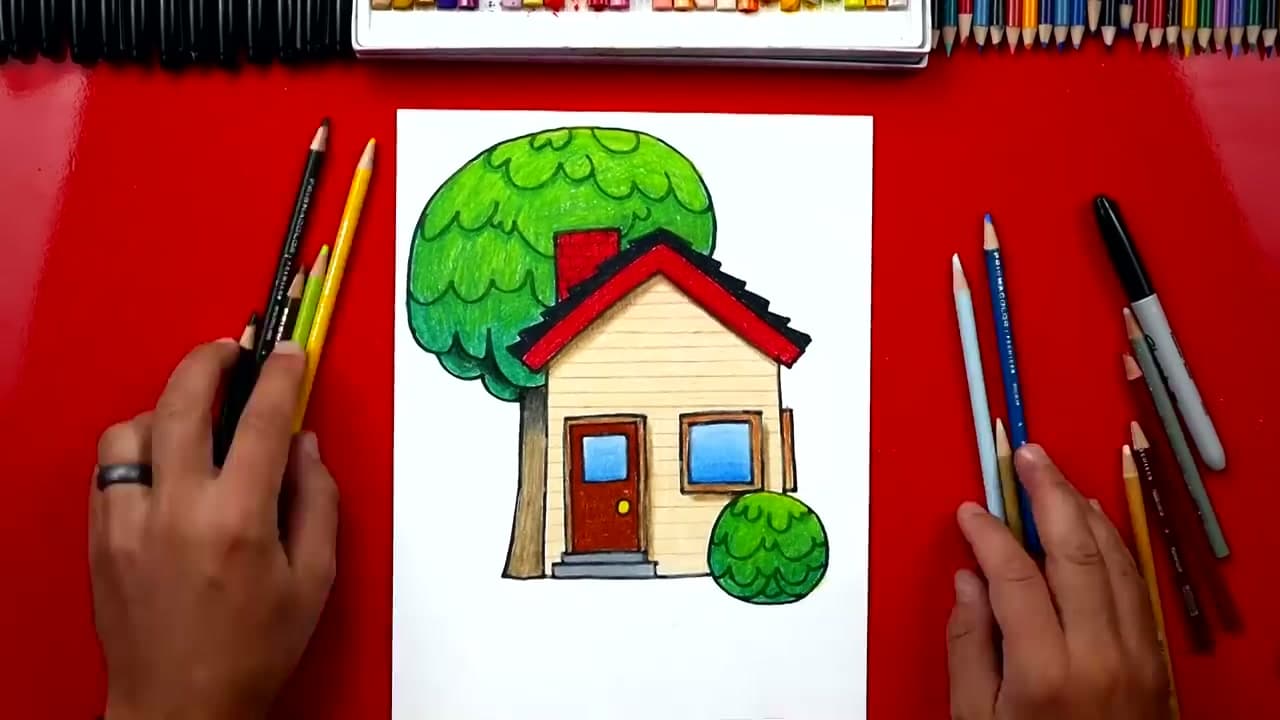
The finished result: How to Draw a House: Cartoon Cottage Step by Step
Also in:Painting

A cartoon house looks complicated until you break it down. It is a peaked box with a triangle on top, a few rectangles for the door and windows, and a bunch of small U-shapes for the leaves on the tree. Once you draw the parts in the right order, the cottage shows up on its own.

This tutorial follows Art for Kids Hub's house emoji lesson with a dad-and-kid format and an overhead view of the paper. It is designed for younger artists but works equally well as a five-minute warm-up for older kids or adults who want a confident win on the page.

Grab a black marker, a sheet of drawing paper, and colored pencils for the finish. Work from the bottom up. The shrub in the front comes first because it sets the position of everything else. Take the lessons slow on the roof and the door so the proportions stay friendly and cartoony.

A house is the cube exercise with windows on it. If the sketching and shading here feel like guesswork, the fundamentals - pencil grades, the light-pass method and picking a light source - are at how to draw.

Why a box and a triangle work

Almost every house you have ever seen is a rectangle with a roof on top. Get those two shapes sized right and the drawing already reads as a house before a single window goes in. Keep the walls a little wider than they are tall and the roof peak low. That squat shape is what says cottage.

Making the house look 3D

The side window in this lesson is the first hint of depth. Take it further by drawing the side wall: from each front corner, run a short line back at the same slant, then close it with a vertical. The roof gets a matching slanted edge along the top.

The next step up is two-point perspective. Put two dots far apart on a horizon line, draw one vertical for the nearest corner, and pull every top and bottom edge toward one dot or the other. It takes ten minutes to learn and makes any building look solid.

Details that sell it

  • Crossbars in the windows and a sill under each one
  • Smoke curling out of the chimney
  • A wiggly path from the door to the edge of the page
  • A fence, flower boxes or a mailbox

Add them after the outline is done so they do not crowd the main shapes. A tree beside the house helps too - how to draw a tree covers a fuller one than the leafy cloud here, and how to draw mountains gives you a backdrop.

Haunted house or snowy cottage

For October, tilt the walls a few degrees, crack a window, add a crooked shutter and a bare tree. Color it gray and purple and drop in a ghost or a pumpkin on the steps. For December, pile a thick white layer on the roof, add icicles along the edge and warm yellow light in the windows.

House drawing ideas to try next

  • Two-story family home. Stack a second row of windows above the door and make the walls taller than they are wide.
  • Treehouse. Draw a small box with a peaked roof sitting in the branches, then add a rope ladder hanging down.
  • Gingerbread house. Wavy icing along the roof edge, gumdrops on top and candy windows. Add a gingerbread man by the door.
  • A street of houses. Draw three or four in a row, each a different height and roof shape, so the street does not look copied.
  • House at night. Color the sky dark blue, the windows bright yellow and add a moon over the chimney.

Common mistakes

  • No roof overhang. A roof that stops flush with the walls looks like a tent. Push it past the walls on both sides.
  • Windows not lining up. Tops of the windows and door should share one line.
  • Converging lines. Walls that lean toward each other make the house look like it is falling. Keep verticals straight up and down.
  • Starting too big. Leave room for the roof and the tree, or the chimney runs off the page.
What you'll need

Step-by-step guide

7 steps, about 9 minutes. Tap a picture to jump to that step. Your progress saves automatically.

Tick each step off as you go.

  1. Step 1: Draw the Front Shrub and Start the Baseline

    Watch this step · 0:18

    Place your paper in portrait orientation. With your black marker, draw a small circle in the bottom-right area of the paper for the shrub that sits in front of the house. Keep it about the size of a lime - small enough to leave room for the whole house and a tree above it.

    Now run a horizontal line out of the left side of the shrub. That line is the ground line and the bottom edge of the house. Stop the line at the right side of where the house will sit.

    Tip:

    Position the shrub low and slightly to the right of center. If you start it dead-center, the house ends up crowding the left edge of the paper and the tree has nowhere to go.

    Back to all steps

  2. Step 2: Add the Walls and the Peak

    Watch this step · 0:55

    From the right end of the baseline, draw a vertical line straight up for the right wall. From the left end of the baseline, draw a matching vertical line up to the same height for the left wall.

    For the roofline, draw an upside-down V on top - go up from the top of the left wall to a center point, then back down to the top of the right wall. Aim the peak right in the middle so the house looks balanced from the front.

    Tip:

    The peak does not have to be tall. A short, wide triangle looks more like a cottage; a steep narrow one starts to look like a tower.

    Back to all steps

  3. Step 3: Build Out the Roof Overhangs

    Watch this step · 1:18

    Now widen the roof so it overhangs the walls. From the top of the left wall, draw a short line that pushes out past the wall to the left, then come back up at a matching angle to mirror the original roof slope.

    Do the same thing on the right side - small overhang out, then a parallel line going up. Connect the two new top lines with a second, smaller upside-down V across the top of the roof. The roof now has thickness.

    Tip:

    Keep the two roof slopes parallel. If the inside slope and the outside slope head different directions, the roof reads as broken instead of stylized.

    Back to all steps

  4. Step 4: Add Shingles and the Chimney

    Watch this step · 2:25

    Start at the peak of the roof. Draw a zigzag down the front face of the roof - short line, drop, short line, drop - to suggest a row of shingles along the front edge. Repeat the same zigzag down the right slope of the roof until it meets the wall.

    For the chimney, drop down the left side of the roof and draw a small upright rectangle. Connect a slightly higher matching line and close the top across. The chimney sits on the back slope of the roof, so the line closest to the peak should be taller than the line on the outside.

    Tip:

    You only need a handful of shingle teeth on each side. More than eight and the roof starts looking busy.

    Back to all steps

  5. Step 5: Draw the Front Steps and the Door

    Watch this step · 3:35

    At the bottom of the house, draw two small stacked rectangles to make a pair of front steps. The lower step is wider than the upper one - a quick way to suggest depth.

    For the door, draw a tall narrow rectangle in the middle-left of the wall, starting from the top step. Repeat the same shape just inside it for the door frame border. Add a small square near the top of the door for the door window, drawing an L first and then an upside-down L to close it. Finish with a tiny circle for the doorknob.

    Tip:

    Center the door over the steps. If the door floats above one of the steps, the cottage looks like it cannot decide where the front entrance is.

    Back to all steps

  6. Step 6: Add the Front Window and Side Window

    Watch this step · 4:30

    Next to the door, draw a square for the front window using the same L-shape trick: draw an L, then an upside-down L to close the box. Repeat a smaller box just inside for the window frame.

    On the left wall of the house there is one more window - a small rectangle on the side. Draw a short line out from the wall at the top of where the window goes, a matching short line at the bottom, and connect them. That side window catches the eye and makes the cottage feel three-dimensional.

    Tip:

    Match the height of the front window to the top of the door for a cleaner look. Two different heights pull the eye in opposite directions.

    Back to all steps

  7. Step 7: Draw the Tree, Add Leaf Texture, and Color the Drawing

    Watch this step · 4:40

    Behind the house on the left side, draw a tree trunk that curves out at the base and connects into the wall. Then sketch the canopy: start with a backwards J shape coming up from the trunk, add two more U-shapes to round it out, and curve the top of the canopy across and over the roof, ending where the roof meets the right side.

    Fill the canopy with the leaf texture. Draw rows of small U-shapes connected together to look like clumps of leaves, working across and down. Add the same U-shape texture across the top of the front shrub.

    Once the marker outlining is done, color the drawing in. Tan or yellow walls, a red roof, blue windows, a brown door, and green for the tree and shrub. Take your time on the coloring - this is where the cottage really comes to life.

    Tip:

    You do not have to match the leaf pattern exactly. A loose handful of U-shapes reads as leaves; trying to make them perfectly even makes the tree look stiff.

    Back to all steps

Keep going

How to Draw a Christmas Ornament

Products Used

The Checklist

How to Draw a House: Cartoon Cottage Step by Step

Tools
4
Materials
3
Steps
7
Video
9 min

Tools we recommend

As an Amazon Associate we earn from qualifying purchases. Links on this page may be affiliate links - clicking them and buying doesn't change your price, but helps support CraftingStepByStep.

Tags

The Crafter's Weekly

New crafts tutorials, every Sunday

One short email with the week's best step-by-step guides. Free, no spam, unsubscribe anytime.

Test your knowledge

Did the lesson stick? Start with this one.

5 questions covering what you just read. No signup, no score saved, and you can stop after this one.

Question 1 of 5

What size is the shrub circle in the bottom-right?

Quick reference

Key takeaways from How to Draw a House: Cartoon Cottage Step by Step

5 questions, answers, and one-line explanations. Tap to expand.

  1. 1.What size is the shrub circle in the bottom-right?

    Answer: About the size of a lime

    Lime-sized - small enough to leave room for the whole house and a tree above.

  2. 2.For the roof, what shape goes on top of the walls?

    Answer: An upside-down V (peaked roof)

    Upside-down V from one wall top to the other - the basic peaked roofline.

  3. 3.How do you give the roof an OVERHANG with depth?

    Answer: Draw a second smaller upside-down V above the first, connecting the overhanging edges

    A second V across the top of the roof reads as roof depth and visible eaves.

  4. 4.How do you suggest shingles on the roof?

    Answer: Zigzag a line down the front face and side slope of the roof

    Quick zigzag pattern reads as shingle rows without drawing each one.

  5. 5.What trick speeds up drawing the door window?

    Answer: Draw an L, then an upside-down L to close the box

    Two L shapes make a clean square fast - same trick used on the front window.

Did this work for you?

What's next

Related collections

Curated theme pages that include this tutorial.

Similar tutorials

Hand-picked next reads based on the one you just finished.

Liked this crafts tutorial?

Pick the crafts you want to hear about. One email every Sunday with new step-by-step tutorials. No spam, easy to unsubscribe.

Get more like this in your inbox

Weekly digest. Pick the categories you want. Unsubscribe anytime.

Send me tutorials about

We only email about new tutorials. Easy unsubscribe anytime.