How to Knit a Dishcloth
Source: NimbleNeedles • Full tutorial: www.craftingstepbystep.com/knitting/how-to-knit-a-dishcloth
- Difficulty
- Easy
- Hands-on time
- About 2 hours 30 minutes
- Cost
- About $4 to $8
- Makes
- 1 knitted dishcloth

Tools
- Size 7 (4.5 mm) knitting needles
- Tapestry needle
- Small scissors
- Row counter
Materials
- Worsted weight cotton yarn, main color
- Worsted weight cotton yarn, contrast color
Steps
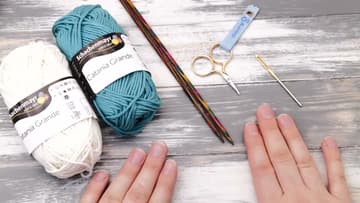
1. Gather cotton yarn, needles and a tapestry needle
You need less for this than for almost any other knitting project. Worsted weight cotton, size 7 (4.5 mm) needles, scissors and a tapestry needle.
Tip: One ball of worsted cotton makes two or three cloths. Buy two colors and alternate which one is the body and which one is the edge.
2. Cast on 32 stitches
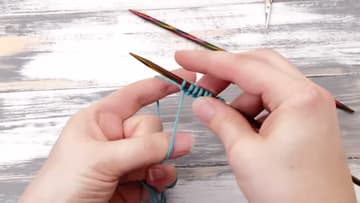
Cast on 32 stitches with a long tail cast on and leave yourself a tail of 5 or 6 inches. You weave that tail in at the very end, and a short one is miserable to work with.
Tip: If your cast on edge comes out tight, cast on over a needle one size larger and switch back for row 1.
3. Knit five rows of garter stitch
Knit every stitch across five full rows. No purling yet.
Tip: Garter rows are easy to count from the side of the fabric: every ridge you can see is two knitted rows.
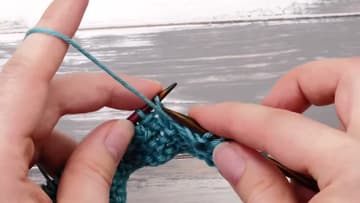
4. Work the moss stitch repeat
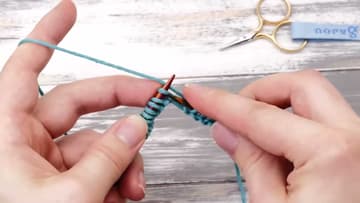
Row 6 is where the texture starts. Knit three, then alternate knit one, purl one across until three stitches remain, and knit those last three.
Tip: Bring the yarn to the front to purl and to the back to knit, and pass it between the needle tips rather than over the top of one.
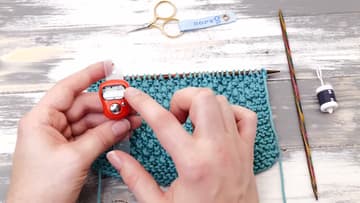
5. Keep track of the row you are on
Thirty six rows of a four row repeat is exactly the sort of thing you lose your place in. A clicker counter on your finger solves it: one click at the end of every row, with the repeat written on a scrap of paper so you can cross lines off as you go.
Tip: Mistakes in a dishcloth are not worth ripping back for. An extra purl in the middle of row 22 will never be found again once the cloth is wet.
6. Knit four garter rows across the top
Row 41 is the last moss row. From row 42, knit every stitch for four rows straight, the same way you started the cloth.
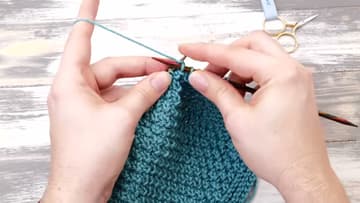
7. Join the white yarn for the contrast edge
Drop the teal and start knitting with the white. There is no special join here, no splicing, no weaving as you go.
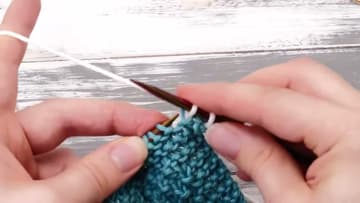
8. Bind off in the contrast color
Cut the teal a few inches from the fabric and tie the two tails together in a small knot while the stitches are still on the needle. The knot steadies the color change and it vanishes once the ends are woven in.
Tip: If the bound off edge is drawing in, work it again with a needle one or two sizes larger.
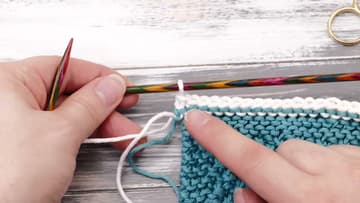
9. Knit a little hanging loop
One stitch is left on the needle. Do not cut the yarn.
Tip: Twisting each stitch as you lift it onto the left needle is technically wrong and makes this cast on much faster. On a strap this short, nobody will ever know.
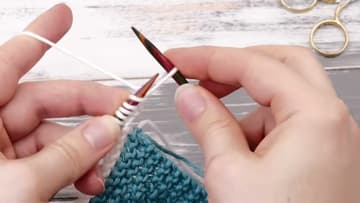
10. Sew on the loop and weave in the tails
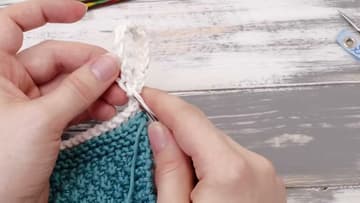
Thread the strap's tail onto a tapestry needle and stitch its free end down to the same corner the strap grows out of, then hide the rest of that tail inside the strap itself. Four tails are left.
Tip: A sharp tapestry needle makes this far less fiddly than a blunt one when you are going through the ridges rather than around them.