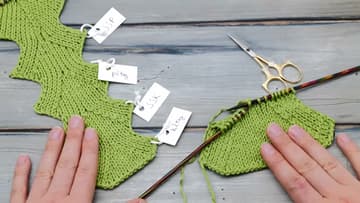
How to Decrease in Knitting - K2tog, SSK and Two More
Source: NimbleNeedles - Two • Full tutorial: www.craftingstepbystep.com/knitting/how-to-decrease-in-knitting
- Difficulty
- Easy
- Hands-on time
- About 30 minutes

Tools
- Knitting needles in the size your yarn calls for
- Stitch markers
- Small sharp scissors
Materials
- Smooth worsted weight yarn in a light, solid color
- A practice swatch about 20 stitches wide in stockinette
Steps
1. Insert the Right Needle Through Two Stitches at Once
Work along the row to the spot the pattern marks. Instead of putting the right needle into one stitch, push the tip through the first two stitches on the left needle at the same time, entering from left to right the way you would for any knit stitch.
Tip: Keep the needle tip low and flat as it goes in. Angling it up splits the strand instead of passing under both loops.
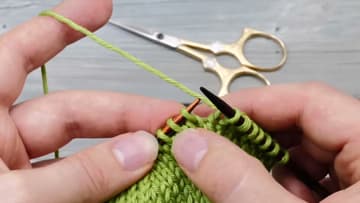
2. Wrap the Yarn and Pull It Through Both Stitches
Take the working yarn over the right needle counterclockwise, the same wrap as a plain knit stitch. Draw that loop back through both stitches at once, then slide the old pair off the left needle.
Tip: Pull the new loop through slowly. Two strands make more friction than one, and yanking is how you end up with a stretched, loose decrease that shows.
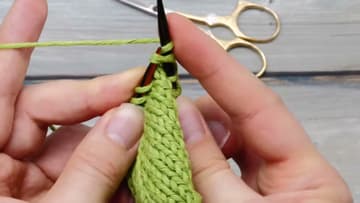
3. Read the Right-Leaning K2tog Line on the Swatch
Lay the swatch flat and look at the column where the decreases stack up. Work a k2tog in the same place every other row and the line of stitches tips to the right, because the second stitch of the pair ends up sitting on top of the first.
Tip: A light solid yarn shows the slant best. On dark or variegated yarn the lean is still there, but you will not be able to read it, which turns checking your work into guesswork.
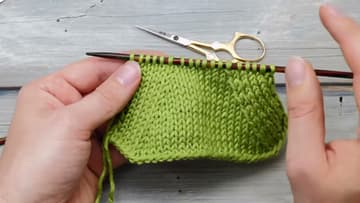
4. Slip Two Stitches Knitwise Onto the Right Needle
The left-leaning partner needs the stitches prepared first. Slip the first stitch knitwise onto the right needle without working it, then slip the second one the same way.
Tip: Slip knitwise, not purlwise. Slipping purlwise leaves the stitches untwisted and the decrease comes out looking like a sloppy k2tog.
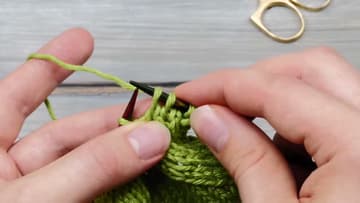
5. Knit the Two Slipped Stitches Through the Back Loop
Put the left needle back through the front of both slipped stitches while the right needle stays in them. Wrap the yarn counterclockwise, pull it through, and drop the pair off the needles.
Tip: Some patterns write this as skp or sl1-k1-psso. They land in the same place, a left-leaning single decrease, so swap one for the other without worrying about it.
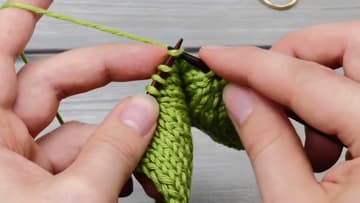
6. Purl Two Stitches Together With the Yarn in Front
On a wrong-side row you decrease with purl stitches. Bring the yarn to the front, then slide the right needle from right to left into two stitches instead of one.
Tip: Check the yarn is in front before the needle goes in. Leaving it at the back gives you an accidental yarn over and a hole where the decrease should be.
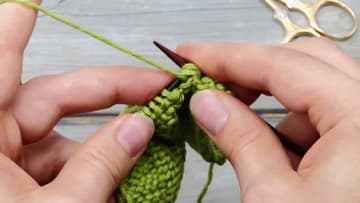
7. Slide the Right Needle Through Three Stitches at Once
To lose two stitches in one move, go into three stitches at the same time and knit them together. Wrap and pull through as usual.
Tip: Double decreases eat stitches fast. Count the row after you work one, because losing two where the pattern wanted one throws the stitch count off for every row that follows.
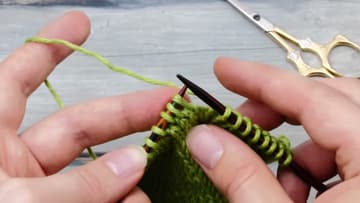
8. Compare the Left-Leaning SSK and Right-Leaning K2tog Edges
Here are all four decreases worked into one swatch, four stitches in from each edge, with a paper tag naming each one. Look at the edges rather than the tags.
Tip: Keep a small labeled swatch like this in your project bag.